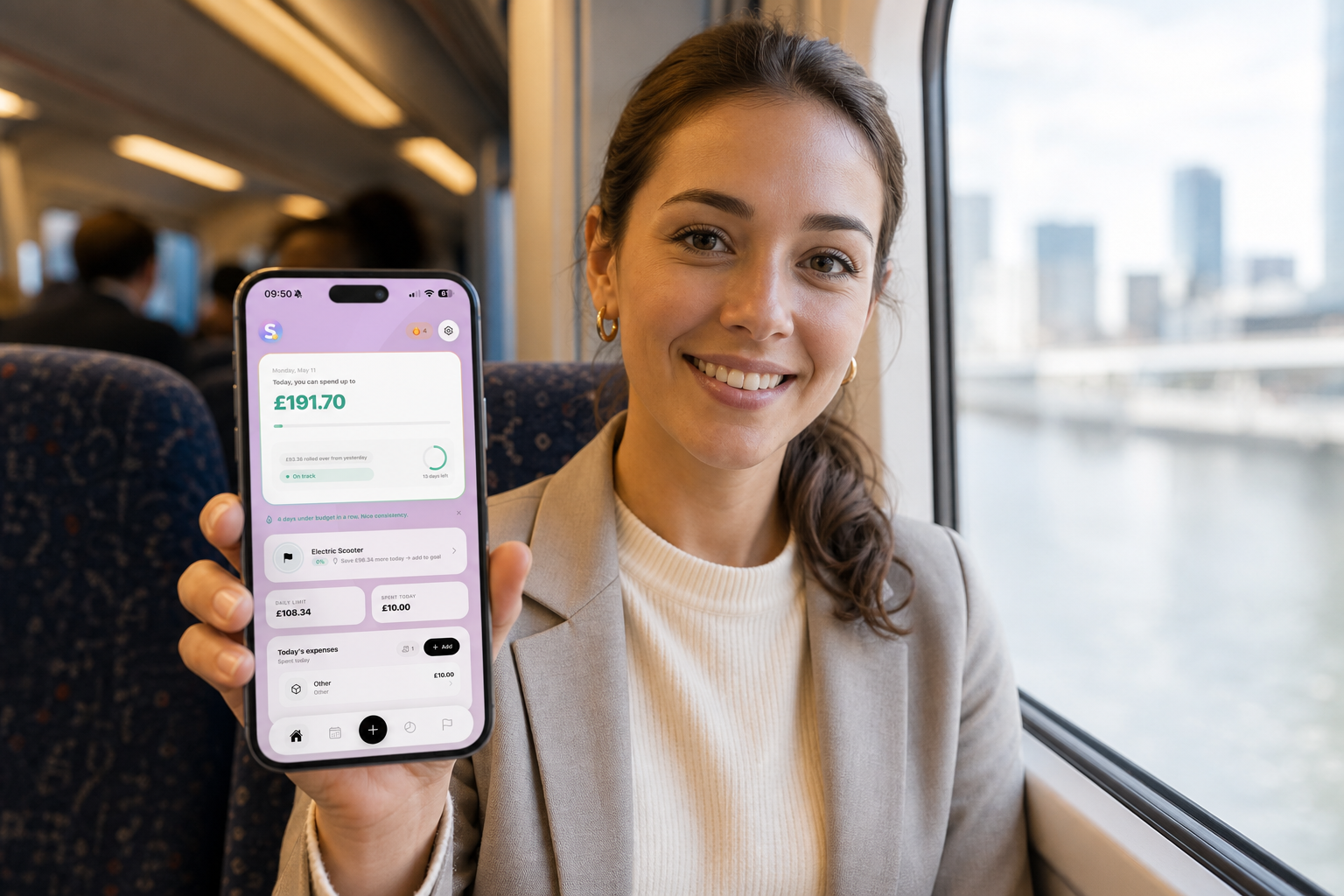
Daily budgeting divides your monthly spending allowance into one clear daily number. Spend less than that number today and the surplus rolls forward to tomorrow. This single shift, from tracking what you have spent to knowing what you can spend right now, makes every money decision faster, simpler, and achievable without spreadsheets or bank connections.
👉 Spendaily does this automatically. Set your monthly budget once and the app gives you a live daily number with smart rollover. Download free on iOS →
What Is Daily Budgeting?
Daily budgeting is a personal finance method that converts your monthly budget into a single daily spending limit.
Instead of watching a monthly total slowly drain and hoping you have enough left at the end, you start each day with a specific number, say, £28, and you either stay within it, overspend it, or underspend it.
The key mechanic is rollover: if you spend only £18 on Monday, the £10 surplus carries forward and Tuesday's allowance becomes £38. Good days visibly reward you. The method works with any income level and requires no category tracking, no bank connection, and no financial expertise.
The Daily Budgeting Formula
(Monthly income − Fixed costs) ÷ Days in pay cycle = Daily allowance
Step 1, Find your monthly take-home pay Use your actual bank deposit figure after tax and National Insurance. For most UK employees paid monthly, this is the figure that hits your account on payday.
Step 2, Subtract fixed costs Fixed costs are non-negotiable, recurring payments: rent or mortgage, energy bills, phone contract, subscriptions, insurance, debt repayments. These leave your account automatically and do not need to be tracked daily.
Step 3, Divide by your pay cycle length If you are paid on the 1st of the month, divide by the number of days in that month. If you are paid every 4 weeks, divide by 28.
Step 4, That number is your daily allowance Everything else, food, coffee, transport, socialising, clothes, impulse buys, comes out of this number.
Worked Example: UK Take-Home of £1,800/month
| Item | Amount |
|---|---|
| Monthly take-home pay | £1,800 |
| Rent | £750 |
| Bills (energy, broadband, phone) | £120 |
| Subscriptions (Netflix, Spotify, gym) | £45 |
| Debt repayment | £80 |
| Total fixed costs | £995 |
| Remaining for daily spending | £805 |
| ÷ 30 days | |
| Daily allowance | £26.83 |
So with a £1,800 take-home, you have roughly £27/day for everything else. That is a tangible, usable number you can apply at the coffee shop, the supermarket, or during a lunch order.
Worked Example: Student on £1,200/month
| Item | Amount |
|---|---|
| Monthly income (maintenance loan + part-time work) | £1,200 |
| Rent | £550 |
| Bills included in rent | £0 |
| Phone contract | £20 |
| Total fixed costs | £570 |
| Remaining for daily spending | £630 |
| ÷ 30 days | |
| Daily allowance | £21.00 |
→ See our full guide: Daily Budgeting for Students, Real Numbers, Real Examples (2026)
How Daily Budgeting Compares to Other Methods
| Daily Budgeting | Envelope Budgeting | Zero-Based Budgeting | |
|---|---|---|---|
| -- | -- | -- | -- |
| Main unit | One daily number | Category pots | Full monthly plan |
| Setup time | Low | Medium | High |
| Daily effort | Very fast (1 check) | Moderate | Moderate to high |
| Handles irregular income? | ✅ Yes, recalculates daily | ❌ Requires monthly reset | ❌ Requires monthly reset |
| Bank connection needed? | ❌ No | ❌ No | Usually yes |
| Best for | Quick decisions, impulse control | Cash users, category lovers | Detailed planners, debt payoff |
→ Full comparison: Daily Budgeting vs Envelope and Zero-Based Budgeting
How to Start Daily Budgeting Today (Step-by-Step)
Step 1: Calculate your monthly take-home pay Check your most recent payslip or bank statement for the amount deposited after tax.
Step 2: List every fixed cost Write down rent, bills, subscriptions, insurance, and loan repayments. Add them up. This is your committed spend.
Step 3: Subtract fixed costs from take-home The result is your "free" money for the month, the pot that daily budgeting divides up.
Step 4: Divide by days in your pay cycle Use 30 for a calendar month, or the exact number of days between paydays if you are paid every 4 weeks.
Step 5: Set that as your daily limit Write it on your phone notes, or use an app that does this automatically with rollover built in.
Step 6: Log what you spend each day At the end of the day, subtract what you spent. Carry any surplus forward. Adjust the next day's number if you overspent.
Step 7: Review once a week A 5-minute weekly check keeps you on track and shows patterns without overwhelming you with daily data.
💡 Shortcut: Spendaily runs steps 4-7 automatically. Enter your income and fixed costs once; the app gives you a live daily number with rollover every morning. Download on iOS →
Why Rollover Is the Key to Making This Work
The biggest reason people abandon budgets is the all-or-nothing feeling. One bad day, an unexpected lunch, a train fare, a spontaneous round of drinks, and the monthly budget feels broken.
Rollover eliminates that.
If your daily allowance is £27 and you spend £35 on Tuesday, your Wednesday allowance adjusts to £19. You are never "off budget." You are always just working with your real position.
The reverse is equally powerful: save £10 on a quiet Monday and Wednesday's number goes up. Over a week of underspending, you can visibly build toward a purchase, a night out, a new item, a small savings goal.
Daily Budgeting and Irregular Income
Daily budgeting is especially effective for irregular earners, freelancers, gig workers, shift workers, and anyone on variable pay.
Monthly budgeting breaks down when income changes because the plan becomes obsolete the moment your paycheck differs from the estimate. Daily budgeting recalculates from your actual balance at any point.
For irregular income:
- Update your monthly income figure as soon as you know what you have received
- Let the daily number recalculate automatically
- On lower-income months, the daily number drops proportionally, rather than a monthly budget that suddenly looks impossible
Is Daily Budgeting Right for You?
Daily budgeting works best if:
- You want a quick "can I afford this right now?" answer
- You tend to overspend early in the month and scramble at the end
- You do not want to connect your bank account to a third-party app
- You have tried category-based budgeting and found it too complex to maintain
- You earn irregular income from shifts, freelancing, or multiple sources
It is less suited to people who need to track individual spending categories in detail (e.g., detailed tax expense tracking for self-employment) or who want to plan large expenses months in advance, though those goals can be added alongside a daily budgeting approach.
→ Next: How to Work Out How Much You Can Spend per Day
FAQ
What is daily budgeting? Daily budgeting is a money management method that divides your monthly discretionary income by the number of days in your pay cycle to give you one daily spending limit. Any unspent amount rolls forward to increase tomorrow's allowance.
How do I calculate my daily budget? Subtract your fixed monthly costs (rent, bills, subscriptions, debt repayments) from your monthly take-home pay, then divide the result by the number of days until your next payday. The result is your daily allowance.
Is daily budgeting better than monthly budgeting? For day-to-day spending decisions, yes. Daily budgeting gives you an immediate, usable number for today rather than a broad monthly total that is easy to lose track of. Monthly budgeting is better for planning large expenses in advance.
What app uses daily budgeting? Spendaily is built specifically around the daily budgeting method. You set your monthly income and fixed costs once, and the app calculates your daily allowance with automatic rollover, no bank connection required.
Does daily budgeting work for irregular income? Yes. Unlike monthly budgeting, which requires a fixed income plan, daily budgeting recalculates from your actual balance. When income varies, you update the starting figure and the daily number adjusts automatically.
How much should my daily budget be? It depends on your income and fixed costs. A useful benchmark for UK young adults: after rent and bills, aim for £20-£35/day for discretionary spending. Use the formula: (take-home − fixed costs) ÷ days in cycle.