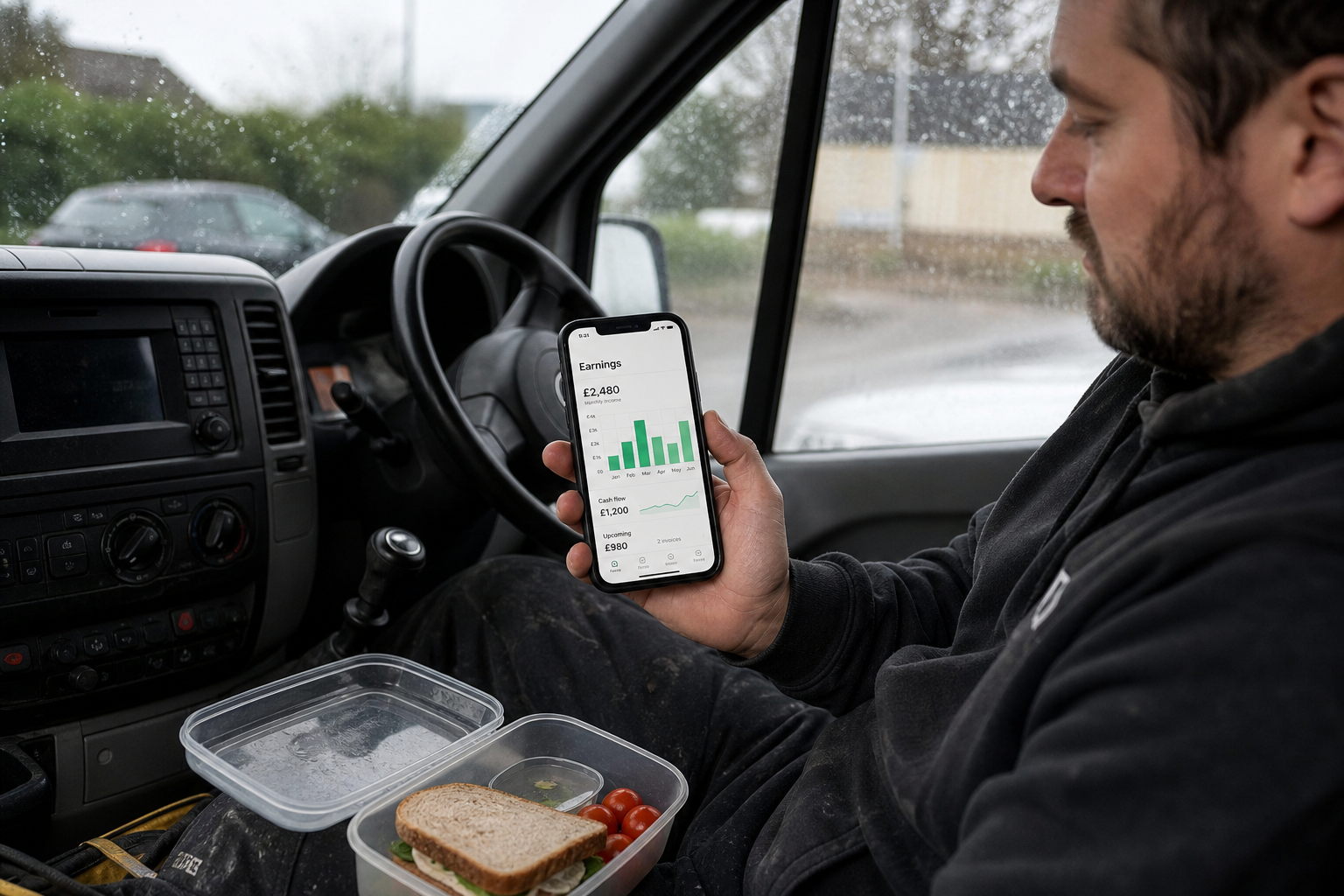
A daily budget calculator takes your after-tax income, subtracts fixed bills, essentials and savings, and divides what’s left by the number of days until your next payday. The result is your daily discretionary spending limit, the maximum you can safely spend on non-essentials each day. You can calculate this with a short template, a spreadsheet or a daily budgeting app.
Step 1, Gather Your Numbers
Before you start, grab:
- Your last 1-3 payslips.
- Recent bank statements.
- A list of regular bills.
You’ll need:
- Take-home income per pay period.
- Fixed monthly bills (rent, utilities, phone, subscriptions).
- Average monthly spending on essentials like groceries and transport.
Round to the nearest pound. This doesn’t have to be perfect to be useful.
Step 2, Fill In the Template
Here’s a simple template you can copy into a notebook or spreadsheet.
- Pay period (monthly / weekly / fortnightly):
- Take-home income for this period: £____
- Fixed bills due in this period (rent, council tax, utilities, phone, internet, insurance): £____
- Essential spending (food, basic toiletries, transport, minimum debt payments): £____
- Savings and sinking funds (emergency fund, annual costs, goals): £____
- Discretionary pot = income − bills − essentials − savings: £____
- Number of days in pay period: ____
- Daily budget = discretionary pot ÷ days: £____ per day.
Once you’ve filled this in once, you can reuse it each time your income or bills change.
Step 3, Work Through a Monthly Example
Imagine you’re paid monthly.
- Step 2, Take-home income: £2,400.
- Step 3, Fixed bills: £1,350.
- Step 4, Essentials: £450.
- Step 5, Savings/sinking funds: £150.
Discretionary pot (Step 6):
- £2,400 − £1,350 − £450 − £150 = £450.
If there are 30 days between paydays:
- Daily budget (Step 8) = £450 ÷ 30 = £15/day.
That £15/day is the amount you can spend on non-essentials while keeping bills and savings covered.
Step 4, Weekly and Fortnightly Examples
Weekly Pay Example
- Take-home income: £500/week.
- Fixed weekly bills and essentials: £360.
- Weekly saving: £40.
Discretionary pot:
- £500 − £360 − £40 = £100.
Daily budget:
- £100 ÷ 7 ≈ £14/day.
Fortnightly Pay Example
- Take-home income: £1,000/fortnight.
- Fixed bills and essentials in those two weeks: £720.
- Savings and sinking funds: £80.
Discretionary pot:
- £1,000 − £720 − £80 = £200.
Daily budget:
- £200 ÷ 14 ≈ £14/day.
Notice that the exact same daily number can come from different pay schedules. The calculator works the same way either way.
Step 5, Turn Your Calculator Into a Simple Spreadsheet
You can automate this template with a tiny spreadsheet.
Columns might be:
- A: Description.
- B: Amount.
Rows:
- 1: Take-home income.
- 2: Fixed bills.
- 3: Essentials.
- 4: Savings/sinking funds.
- 5: Discretionary pot.
- 6: Days in period.
- 7: Daily budget.
Formula ideas:
- Discretionary pot (B5) = B1 − B2 − B3 − B4.
- Daily budget (B7) = B5 ÷ B6.
Once set up, you only need to edit a few cells when something changes.
Step 6, Adjust Your Daily Budget When Life Changes
Your daily budget isn’t fixed forever.
Update your calculator when:
- Your income changes.
- You move or your rent changes.
- A major bill starts or ends.
- You decide to save more or less.
Re-running the template takes a few minutes and gives you a fresh daily number that fits your new reality.
Step 7, Use a Daily Budget App as a Live Calculator
If you’d rather not run a spreadsheet at all, a daily budgeting app can act as your live calculator.
With Spendaily, you can:
- Enter your income, bills and savings once.
- Let the app calculate your daily allowance automatically.
- See your “safe to spend today” number every time you open it.
- Adjust your settings when something changes.
The calculator logic is the same, the app just runs it for you in the background.
Keep reading: Daily Budgeting: The Complete Guide to One Simple Number, How to Budget Daily: 7 Simple Steps and Daily Budget Calculator: Find Your Daily Spending Limit.
FAQ
How accurate does my daily budget calculation need to be?
It doesn’t have to be perfect. A reasonable estimate based on recent bills is enough. You can refine the numbers over the next few months as you see how reality compares.
Should I include occasional expenses, like car repairs, in the calculator?
Yes, via sinking funds. Estimate what you spend on these in a year, divide by 12 (or by your pay periods), and include that amount on the “savings and sinking funds” line.
What if my discretionary pot is negative?
If your calculation leaves you with less than zero, your fixed costs and savings exceed your income. This is a sign you need to adjust something bigger, housing, transport, income, or debt payments.
Can I have different daily budgets for different weeks?
You can. Some people use a lower daily number in weeks with big bills and a slightly higher one elsewhere, as long as the average still fits the pot.
How often should I use the calculator?
Use it whenever your situation changes, and at least every few months. You don’t need to recalculate daily, that’s what the allowance is for.